
Signed term sheet. Congratulations — you’re now at the beginning of the hard part.
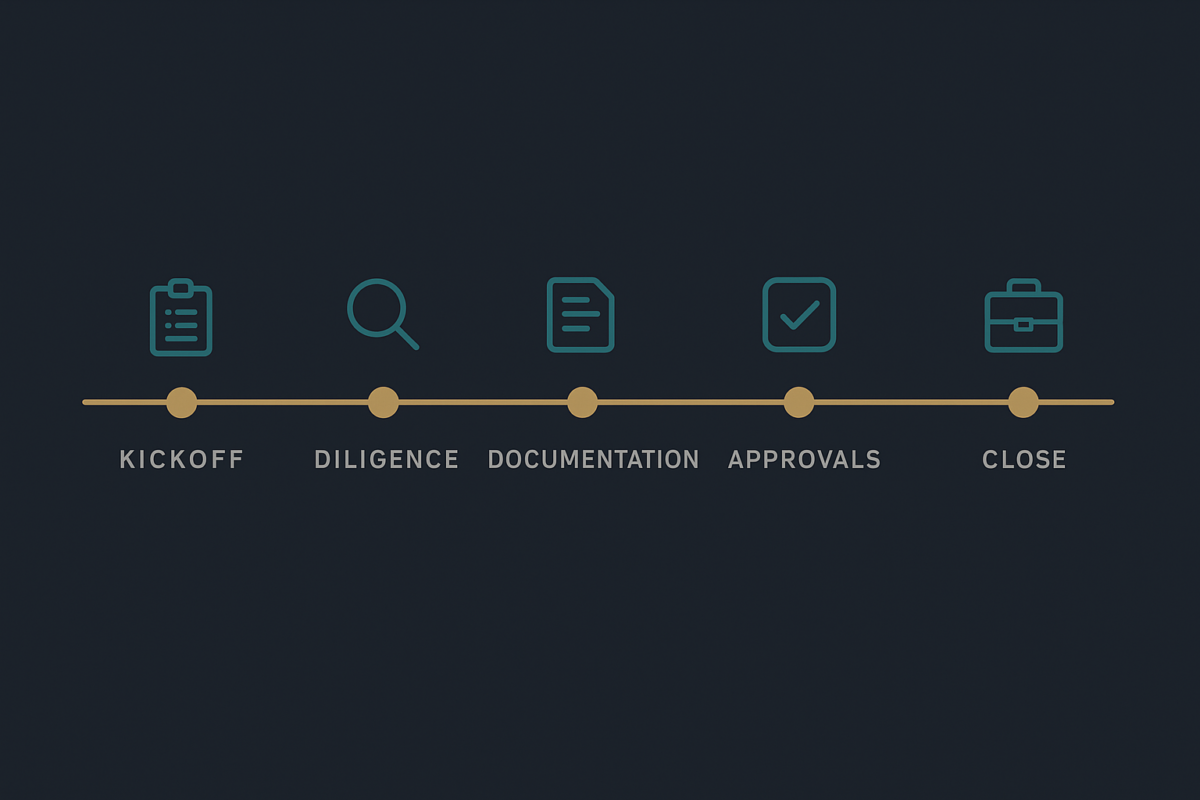
The period between term sheet and close is where most deal momentum is lost: documents that stall in review queues, approvals that nobody tracked, diligence requests that turned into email archaeology projects. This guide maps the actual deal timeline so you know what to expect, who’s responsible at each stage, and what to protect.
Why the timeline matters more than it seems
Time kills deals. Not always dramatically — more often through a death of small frictions. Each day the deal is open is a day where market conditions, competing priorities, or seller fatigue can change the calculus. A two-month process that becomes five months is also significantly more expensive: more legal hours, more management distraction, more room for “new information” to surface and complicate.
Phase 1: Kickoff and diligence plan (days 1–7)
This phase determines whether the rest of the process is controlled or reactive.
What to align on:
- Scope of each diligence stream (financial, legal, commercial, technical, security, HR)
- Workstream owners on both sides
- Q&A rules: where questions get asked, who can respond, response SLAs
- Data room access: who gets invited, at what level, when staging expands
Teams that skip the kickoff and go straight to document sharing spend the next four weeks managing an inbox of spreadsheet requests. Teams that spend three days aligning on structure save those four weeks.
Phase 2: Confirmatory diligence (weeks 1–4+)
The bulk of the process. Each stream has its own rhythm:
| Stream | Typical documents requested | Common friction point |
|---|---|---|
| Financial | P&L, balance sheet, cash flow, revenue recognition | Inconsistent KPI definitions across periods |
| Legal | Material contracts, IP, cap table, litigation history | Missing signatures on older documents |
| Commercial | Cohort data, pipeline, customer concentration | Metrics defined differently than anticipated |
| Technical | Architecture, security posture, code review | Underestimated scope of tech debt documentation |
| Security/Privacy | Access controls, incident history, compliance posture | No documented security baseline existed |
On security specifically: diligence teams now routinely ask for security controls evidence. The IBM 2025 Cost of Data Breach Report ($4.4M average breach cost) has made security governance a material diligence item, not an afterthought. A virtual data room helps demonstrate controlled access and generates the audit trail evidence that supports these conversations.
Phase 3: Definitive documentation (weeks 2–6, parallel with diligence)
Legal drafting typically starts in parallel with diligence. The main risk: version confusion. Multiple lawyers from multiple parties generating competing drafts is standard. The solution is controlled: all versions live in a single, clearly named location in the VDR.
Key documents in most deals:
- Share purchase agreement or subscription agreement
- Disclosure schedules (attached to SPA; require careful review)
- Employment and retention arrangements for key individuals
- Updated corporate governance documents (board rights, consent matters)
Naming discipline matters here. Documents named Final_SPA_v3_CLEAN_revised_FINAL.docx signal exactly the kind of document management maturity that the other side is evaluating.
Phase 4: Approvals and conditions (parallel, weeks 3–6)
Often underestimated. Depending on deal structure:
- Board and shareholder approvals
- Regulatory notifications (jurisdiction-specific; UK, US, and Canada have different thresholds)
- Third-party consents for contracts with change-of-control provisions
- Lender waivers if debt is involved
Track these on a closing checklist with an owner and status for each. Someone should own the closing checklist as their primary job for the last three weeks.
Phase 5: Signing and close (final 3–5 days)
The logistics phase. Prepare:
- Final execution versions in a “Closing” folder with restricted access
- Funds flow statement with banking verification procedure
- Final cap table confirmation
- Closing checklist signed off
Where deals most often slow down (with fixes)
Untracked Q&A: When questions arrive by email, they get lost. Use a VDR’s Q&A module or a single tracked spreadsheet with owner and response status.
Document version chaos: Restrict upload rights; use staged folders (staging → review → approved).
Late-surfacing surprises: Surface known issues early with context. The discovery cost of hiding a problem until week 6 is always higher than the disclosure cost at week 1.
Approvals without ownership: Assign one person to track all third-party consents and regulatory items from day 1.
FAQ
A well-prepared, clean-record seller with a motivated buyer can close in 6–10 weeks. Complexity (multiple jurisdictions, regulatory approvals, contested representations) adds time.
Before the term sheet if possible. A lightweight investor-ready VDR that you’ve maintained during fundraising is an asset, not overhead. See how to organise your business data for pre-process setup.