
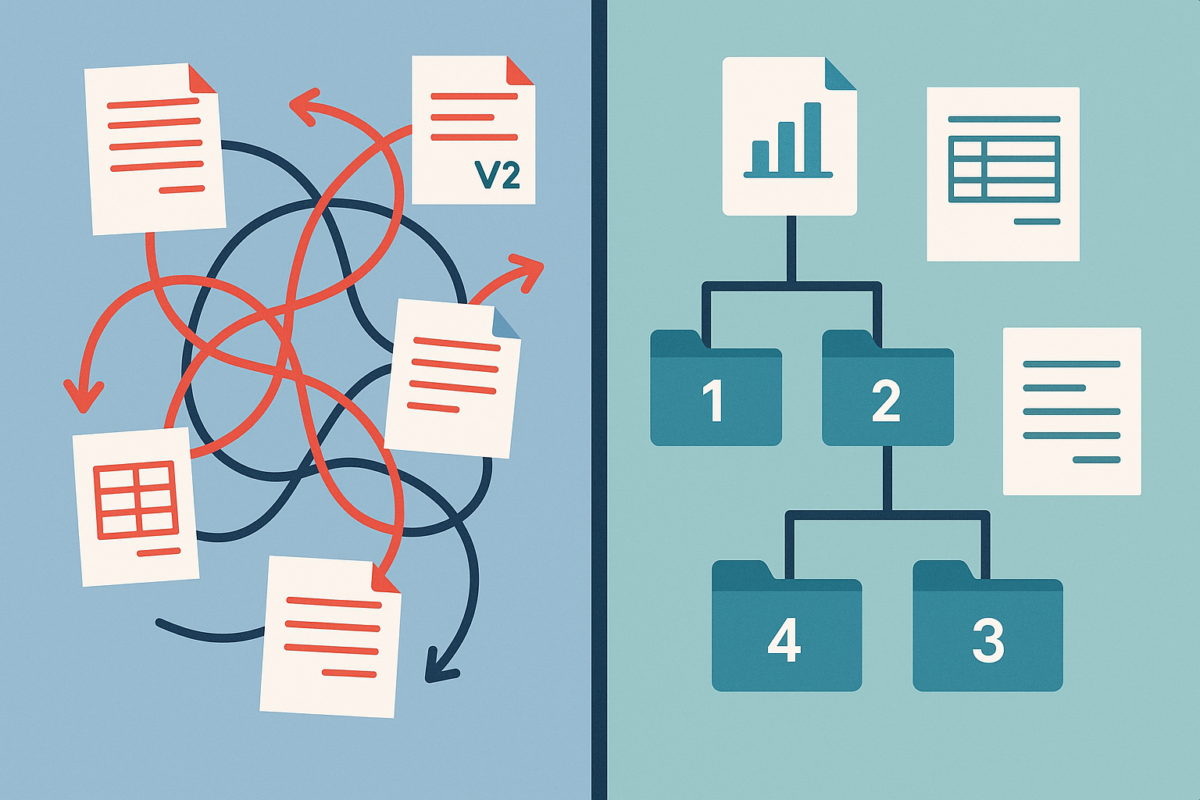
A virtual data room solves the sharing problem. It doesn’t solve the underlying data problem. If your files are inconsistent, missing, or scattered across four drives and three email chains, uploading them to a VDR just means your chaos is now neatly permissioned.
Getting investor-ready starts with what you have, not with the platform you use to share it. This guide walks you through the preparation — what to collect, how to structure it, and how to check it before anyone’s eyes reach it.
The framing that changes everything
Most founders think about data organisation as “what do I need to share?” The better frame is: “what questions will an investor have, and can I answer them in under 5 minutes?”
Speed of evidence is a signal. When you can produce a clean revenue cohort in one click, that demonstrates operational maturity. When you need three days to reconcile it, that demonstrates risk.
Step 1: Scope what you’re preparing for
A seed round, growth equity raise, and acquisition due diligence each have different emphasis, but most overlap in the fundamentals. Define upfront:
- Stage: Pre-seed/seed (investors want traction story); Series A+ (investors want metrics depth); M&A (buyers want everything)
- Jurisdiction: UK, US, and Canada each have regulatory and privacy differences that affect what documents you’ll need
- Sensitivity level: staged sharing means you start with less and expand as investor seriousness increases
Step 2: Choose one source of truth per data type
The quickest way to produce contradictory numbers is to pull from multiple systems. Assign:
| Data type | Source of truth |
|---|---|
| Revenue and financials | Accounting system (Xero, QuickBooks, NetSuite) |
| Customer and pipeline | CRM (Salesforce, HubSpot) |
| Product analytics | Analytics platform (Mixpanel, Amplitude, GA4) |
| HR and headcount | HRIS (BambooHR, HiBob, Rippling) |
| Cap table | Carta or equivalent |
Lock one reporting period’s snapshot as the “investor version.” Investors want repeatable numbers, not a moving target.
Step 3: Build a folder structure that mirrors how investors think
A simple numbered structure reduces navigation questions:
01_Corporate
02_Financial
03_Tax
04_Sales_and_Marketing
05_Product_and_Technology
06_Legal
07_HR_and_People
08_Security_and_Privacy
09_Appendices
Within each folder: consistent naming, no duplicates, current versions only.
Step 4: Name files consistently
Ambiguous file names like “financials.xlsx” or “contract_final_v2.pdf” create confusion and signal poor document management. Use:
YYYY-MM_Description_Entity_Version.ext
Examples:
- 2026-Q1_Financials_Consolidated_v1.pdf
- 2026-03_CustomerMasterAgreement_UK_Signed.pdf
- 2025_AnnualReport_v1.xlsx
Step 5: Add context notes to each folder
Don’t assume investors know how to read your documents. Add a short README in each folder answering:
- What’s in this folder?
- How should numbers be interpreted (definitions, exclusions)?
- Who to contact for questions on this section?
This reduces the email volume you’ll manage during diligence by 40–60%.
Step 6: Implement permissions before you invite anyone
In your VDR, create role groups before sending any invitations:
- Investor – Initial access: pitch deck, KPI table, financial summary, high-level customer notes
- Investor – Advanced access: full financials, cohort data, key contracts, team details
- Legal counsel: stream-specific access
- Internal team: staging folder access only
Enable watermarking and view-only modes for sensitive documents. Audit logs give you visibility into what investors are reading — useful intelligence for anticipating questions.
On access controls: disciplined data sharing is not paranoia. The IBM 2025 Cost of Data Breach Report puts the average breach cost at $4.4M. A deal process involves sharing sensitive business information with external parties — it’s precisely the moment when access governance matters.
Step 7: Run a pre-flight check
Before anyone external touches the room:
- Search for files named “draft,” “final_final,” “old,” or “copy” — delete or archive them
- Confirm every KPI has a written definition in the appendix
- Spot-check 20 contracts for signature pages and correct counterparty names
- Verify personal data minimisation — redact employee-level data that investors don’t need
- Create a test user account and verify access boundaries
FAQ
3–6 months before serious outreach if possible. Even a lightweight room with the fundamentals ready prevents the scramble that happens when an investor says “send me your data room” after a first meeting.
Start with what you have and label gaps explicitly in your README notes. An investor seeing “security policy — in progress, expected Q3 2026” is better than an empty folder with no acknowledgment.