
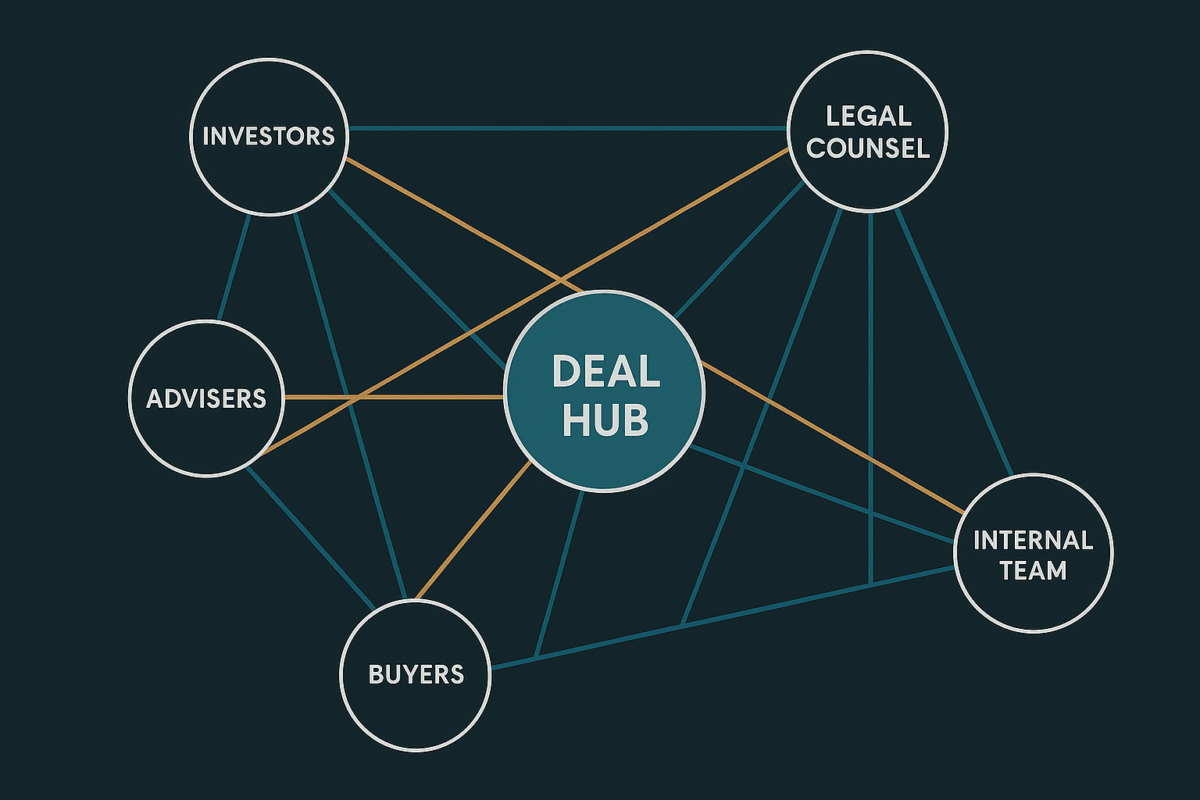
Complex transactions have a characteristic failure mode: not one big problem, but a cascade of small coordination failures. An adviser reviews an outdated document. A buyer asks the same question twice because the first answer was buried in email. Internal teams disagree about numbers because two people pulled from different reports. Nobody can see the full picture.
This guide is about operational control — how to design a stakeholder management process that prevents coordination failures and keeps decision-making moving, without creating so much governance overhead that the deal slows down anyway.
Start with a stakeholder map, not a meeting
Before opening access in your data room, build a map of everyone who needs to be involved:
| Name | Organisation | Role | Information scope | Decision authority | Response SLA |
|---|---|---|---|---|---|
| [Investor] | [Fund] | Decision-maker | Full access | Investment approval | 48 hours |
| [External counsel] | [Law firm] | Executor | Legal stream only | None | 24 hours |
| [Financial adviser] | [Firm] | Executor + Advisor | Financial + deal terms | Recommends | 24 hours |
| [Internal Finance lead] | Internal | Responsible | All streams | Financial approval | 4 hours |
This map is not bureaucracy — it’s the reference document that prevents every “who should be in this email?” conversation for the next 8 weeks.
Define RACI and actually enforce it
RACI (Responsible, Accountable, Consulted, Informed) is worth the 30 minutes to define, because unclear accountability is the mechanism behind most deal delays:
- Financial representations: who prepares them, who signs off, who answers questions?
- Legal document review: who marks up, who approves final versions?
- Security documentation: who owns it, who answers technical questions?
- Diligence Q&A: who coordinates questions, who routes them, what are the SLAs?
Undefined RACI means questions bounce between people until someone escalates, which happens after the delay has already occurred.
The VDR as coordination infrastructure
Document management is stakeholder management. When materials live in email threads, version control collapses and the right information fails to reach the right person.
A virtual data room solves coordination by providing:
- Granular permissions by role: buyers see buyer-facing folders; internal advisers see what they need; executives see dashboards and key items
- Centralised Q&A: one place where diligence questions are tracked, assigned, and answered with a record that persists
- Audit trail: who accessed what and when — useful both for accountability and for anticipating where questions are coming from
- Version control: one current version per document, no “final_final” confusion
On the human element in document security: the Verizon 2026 DBIR found 48% of breaches involved ransomware, with human factors playing a major role. During a complex transaction, many people are moving fast under pressure. Reducing the surface area for accidental disclosure — through controlled sharing, watermarking, and view-only modes — is not paranoia; it’s operational hygiene.
Communication cadence: one rhythm, one channel
Complex transactions generate enormous amounts of communication. The goal is not more communication — it’s more signal and less noise.
Weekly deal call (internal team + advisers): 30 minutes. Cover: completed this week, in-progress with owners, blocked items and what’s needed, upcoming decisions.
Mid-week written status update: 300 words maximum. Use a consistent template. Email or secure message.
Investor/buyer-facing communication: controlled by the deal lead only. Avoid having multiple internal people communicating with counterparties directly — this creates inconsistency.
Decision-making: prevent the “consensus trap”
The consensus trap is when every stakeholder must agree before a decision can be made, so nothing gets decided until someone forces a resolution at a deadline. In deal contexts, this manifests as weeks lost to aligned documentation language, representation wording, or diligence scope.
Design your decision process with:
- Clear decision owner for each category
- Time-boxed input period before decision
- Escalation path when material financial or legal risk is involved
- Decision log linked in the VDR so all parties see what was decided and why
Permission design: least privilege with practical structure
The temptation is to give everyone broad access to avoid access request overhead. The cost is information sprawl and inability to demonstrate controlled sharing during security review.
A workable model:
- Buyers: staged access; view-only on sensitive items; watermarked documents
- External advisers: stream-specific, with upload restricted to staging folders
- Internal contributors: staging folders only — nothing goes live in diligence folders without review
- Executives: summary dashboards + key document access
FAQ
Restrict upload access to a staging folder with a designated reviewer. Enforce: no documents appear in live diligence folders without one internal review step.
Acknowledge the question, route the answer through the Q&A module, and send the Q&A link back. Consistent redirection usually establishes the habit within a week.